Showing posts with label goals. Show all posts

Monday, May 19, 2014

4 Ways to Maximize Your Next Hamfest

The dust has settled and the car has been emptied of coffee cups and ham gear. I've unpacked my bags and begun to organize all the little bits and pieces that followed me home from Dayton. This was a great Hamvention weekend. It was my third year in four and by far the best time yet. On the long drive back to New Jersey, I had some time to ruminate on what made this trip so much better than the last. I've come up with several ideas, but four stick out most. Best of all, they aren't specific to Dayton. So, no matter what Hamfest you might be heading to, here are four way to get more out of the experience:

1.) Go with someone fun


People in our lives generally fall into three categories: people we enjoy, people we don't, and people we have to be be around whether we enjoy them or not. When going to the Hamfest, only take the first kind of people. This might sound simple, but don't pass over it too quickly. Consider that Ham radio--and by extension a Ham Fest--is not for everyone, whether you enjoy them or not. So take someone you enjoy, who also enjoys Ham radio and you'll have a great time. Drag along a friend, spouse, or mother-in-law that cannot understand why you, "waste all that time in the garage fiddling with your radio," and you're both in for some serious spurious emissions that may make RF burns the least of your worries.

2.) Make a Point of Learning Something New


The draw of Amateur Radio is complex. There are the Emcomm types, the CW purists, the PSK314787096505 digital modes types, the "Good Buddy this here ham radio sure beats CB" types, and there are people that want to bounce signals off satellites or the Moon or Mars (at least that's what there antennas suggest). The point is, no matter what you've tried in Ham Radio, there is at least one more things you haven't tried. If you're at a Hamfest, chances are someone there knows about it. Go ask questions, sit through a forum,or  grab some literature. You never know what you'll discover. For instance, I learned that my Raspberry Pi, is a really good platform for building a repeater controller at the Embedded Linux Forum this year at Dayton. Why did I go to that forum? It was the only one where I could find a seat. Did I enjoy it? Yes. Now I have another avenue to explore in Ham radio.

3.) Go With a Purpose and Maybe a List


It is SO easy to come home from a Hamfest with a trunk full of junk. There is a lot of STUFF at any Hamfest, but chances are, you don't need that much stuff. In fact, you might not need any stuff at all and that's perfectly acceptable. The best way to avoid all the Junk in the Trunk is to avoid carbohydrates (sorry I was trying to hold back, but I couldn't resist). The best way to avoid buying a bunch of stuff you don't need is to go with a plan and maybe a list. You might not find what you're looking for, but that gives you an excuse to go to the next Hamfest (win-win). With a solid plan you will be focused on finding something useful. 

Another thing: don't give up. I went to Dayton with a few small bits and pieces on my list: toroids, connectors, a few semiconductors, but at the very top of the list was an Elecraft K1. I've wanted one for a while, but shelling out the money for a new one has been impossible. For months I've been convincing myself I'd find a used one at a Hamfest. When none showed up, I doubled down on Dayton. Like they say, "If you can't find it at the Dayton flea market..." Well, I couldn't and it bummed me out. I was just about to blow some money of something else to satiate my QRP thirst when I spotted a K1 sitting on a table where it didn't belong. Ten minutes later, I was walking off with it after striking a deal that even my XYL thought was reasonable. The point is, know what you're looking for, don't give up, and keep you eyes open.

4.) Talk to People, Meet On-Air Contacts, Join a Club or Group


Ham Radio is social. So be social. It's one thing to know people's on-air voice, but when you can meet them face-to-face, it makes the on-air meetings more interesting and meaningful. Talking to and meeting new Hams is also a great way to initiate more on-air contacts and it's also a great way to find new friends. If you're shy, join a group or a club and slowly wade in to the social interaction. Before you know it, you 'll have more people to go to Ham Fests with and more people who sympathize and offer alternatives next time your XYL puts her foot down on your plan to run a radial field through her rose garden.

Hamfests are a blast. So find one nearby or even one not so nearby and make a day of it. With some forethought, a few friends, a willingness to learn, and a purpose for going, you'll be sure to have an amazing time. Just remember, it's easy to spend money at a Hamfest, but it's how you spend your time there that counts.

73

Wednesday, February 5, 2014

Great Video on CW for Beginners

I've been home sick for the past two days. Feeling under the weather, especially when the weather has been so terrible, gave me far too much time to lay about. I reached the end of my book and there was nothing worth watching on TV, so I jumped on YouTube® to watch a few ham videos. I cruised through the usual reviews and QSO's but then stumbled upon this excellent video by K1OIK. Rather than read me describing it, have a watch.

Sunday, December 15, 2013

Winter Wonderland

The QTH is warm and cozy, but everything outside is frozen. It seems like the bands are as well. This AM a few stations were floating in, but most of them were from Europe and about to go QRT by the time I got on the air, so I switched it up.

I heated up the iron and turned on some old-time Christmas tunes. I soldered away and wound a toroid or two in hopes of getting my new QRPP beacon on the air before the new year. The build is going slowly, but that's because there are so many other things going on this time of year. I don't mind. I love the Christmas season and with three young children, it's a magical time of year, full of plays, shows, rides in the car looking at decorations, and of course...sledding.

I've been pretty lax on my CW lately. I fear I've forgotten more than I remember, so I guess it's about time to get back into it. I really want to be proficient enough to have a few QSOs before the New Year. I had no idea how difficult it was going to be to learn Morse code. I feel like I've tried everything available to me. CDs, apps, on-line tools have all proved useful, but not complete. I really wish I had someone local to work with, but I've visited two clubs in the area and honestly...I want no part in them. One is run like a prison camp and the other is exactly the opposite. Is it impossible to have a Radio club that is both fun and organized? I'm losing faith.

Winter has always been a time of rumination and soul-searching for me, so I apologize if this post is a little too much of a downer. Like all things in life, Ham Radio has seasons and maybe winter is for rebuilding and reinventing. If that's the truth: I've got some work to do, but first, I'm taking my kids out back to go sledding.

Monday, September 16, 2013

Back to Work

Lately, I've spent most of my limited radio time playing with a new antenna and tweaking my QRP rigs. It dawned on me this past weekend that I haven't worked on my CW in quite a while.
If you've read anything on this blog before, you'll know that I am new to CW and that I have been trying to learn the code at 13-15 WPM in hopes of getting on the air without the need to immediately re-learn at a faster speed. I knew at the start that this would make the learning slower and more challenging, but I was dedicated to the process...for a while.

Life has a way of getting between my responsibilities and my hobbies, but things in our house have quieted to a dull roar. The kids are back in school and there is a sense of "normal" again. "Normal" means regular bed times for the kids and an extra hour or two of uninterrupted time for me and the wife. I've been trying to remember to turn off the TV and work on the code. I think it's beginning to pay off.

I jumped back onto http://www.lcwo.net this morning. It has been over a month since my last login, so it took me a few minutes to remember where I was. I dialed the speed back from 15 WPM to 13 WPM and started over at lesson one. Twenty minutes after beginning, I was back through lesson three with 100% copy and 70% copy on my first attempt at lesson four.

I plan on spending the next two weeks, "hitting the "books" hard." I really want to be able to work some of the upcoming sprints and contests on CW. Also, with my tower project on financial hiatus, I want to have a better shot of completing my DXCC before the 2014 Dayton Hamvention. Obviously, CW will help greatly in that regard as I am limited to two wires and possibly a home-brew vertical for operation this winter.

Learning the code is difficult, but I can already feel the glory of knowing it. In fact, I'm becoming so enamored with CW that I find I hardly even pick up the mic anymore in lieu of listening to the slower speed sections of the bands. I'm sure that I will fully embrace the life of a dedicated Morse operator, but I need to focus on really learning to hear over the next two weeks. Wish me luck.

Friday, June 21, 2013

Quick and Dirty Field Day Doublet

Last night I got home with a few hours of daylight to spare (thank you very much Summer Solstice) so I decided to throw a quick and dirty doublet together for Field Day. Like most hams, I have a few (unless you ask my XYL, then it's hundreds) boxes of random "junk" laying around that I use from time to time to experiment, so I pulled out a few bits and pieces to put the antenna together. In case you've never built a doublet, here are my reasons for doing so and the theories that I employed.

There is a lot of confusion surrounding the terms "doublet" and "dipole," so let me wade into the murky waters and explain the difference as I see it. Technically, there is none. They are two names for the same thing. However, the difference, in common parlance, lies in how you feed said antenna and whether the antenna is cut to resonance for a target frequency. 

Typically, a "dipole" is a resonant antenna for a given frequency and is fed with coax. There are many purveyors of 40 meter, 20 meter, 10 meter, etc. dipoles that include a PL259 connection at the center connector to attach your coax. These dipoles are typically resonant near the center of the given bad and give adequate bad with to allow the ham to operate anywhere on the bad without the need for a tuner. Try to load them up on another band then their design frequency however, and noise, smoke, silence, and cursing often occur. 

"But I have a fancy built-in tuner in my rig, so I can load that 40-meter dipole up on 6 through 160, right?" 

Maybe, but the impedances of other bad on a resonant dipole can be amazingly high. So, in short, it's not a good idea to test fate. There are however tuners that will allow you to load up on other bands, but the signal losses of doing so offer drastically diminishing returns. In other words, you might be able to tune that 40-meter dipole up on 160-meters, but it might work as well as loading up a Soup Can. 

A Doublet (again, I'm speaking of "Doublet" as is generally understood. Both "dipole" and "doublet" mean the same thing), is a little different. The basics are the same. You generally cut a doublet antenna to be a half wave long on the lowest frequency you plan to operate. Impedances on other bands will still be amazingly high, but the losses will be much lower and turn our "Soup-Can" into a usable, although compromised, antenna. How? I'm glad you asked.

By using ladder line or open wire feed-line (two wires separated by spacers) the signal losses are dramatically reduced. The ladder line is then fed into a Balanced Line Tuner (or a 4:1 Balun) and then coax to your rig. A Balanced Line Tuner like the CG Antenna Ltd. Remote Auto Tuner is placed where your ladder line meets the ground and powered by a battery (in my case an SLA battery which is charge by a 5W Solar Panel (Pics coming soon) or by a "Bias Tee Power Injector" such as the MFJ-4116. When the auto tuner senses RF energy it quickly measures the SWR and makes the necessary adjustments to put it back in a usable range. Remote auto tuners like the CG can seamlessly deal with the wild impedance differences between bands and allow you to operate on 6 -meters one minute and 40-meters the next. So now you can pick a Saturday and knock out that DXCC you were thinking about getting someday. Maybe, but there are a few other things to consider.

Our 40-meter Doublet and subsequent Balanced Line Auto Tuner are doing their job singingly, but it is important to realize exactly what they are doing. Like a 40-meter resonant dipole, our antenna will project the bulk of it's RF energy 90° to the antenna in both directions, in other words, off the sides of the antenna. This is assuming that the antenna is flat-top and at least 1/4 wave (33 feet or so) above the ground. When we move dow to 20-meters, our antenna will still put the bulk of it's energy out at 90°, but as we go higher in frequency (17-meter, 15-Meter, 12-Meter, etc.) our two predictable lobes will start to break up and lose energy. by 15-meters, there will essentially be 4 lobes at 45° each. I wish I had the ability to plot this out for you, but at the moment I don't. Suffice it to say, that you must consider the trade-offs when ever you deploy a multi-band antenna. 

Wow, that was  a lot of theory to get to my application. So, I decided to deploy a lightweight 66' (half wave on 40-meter) doublet fed with 300Ω Ladder Line. I built this antenna to use for Field Day 2013, but it will also be used regularly when operating portable with my Hendricks PFR-3. That being the case, I wanted it to be pretty bullet-proof without adding too much weight. Also, I wanted to save the nice 500' spool of antenna wire I have to complete an 80-meter full-wave loop this summer. Luckily, my fellow Ham and father recently unloaded a spool of hefty speaker wire on me.


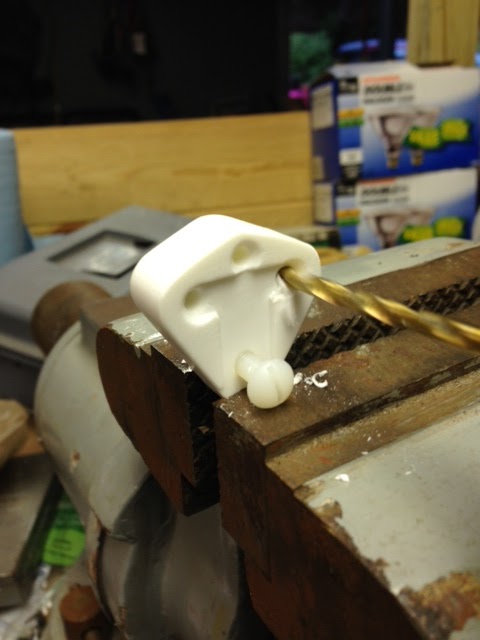
I found this Wireman 814C in a box and drilled the holes a little wider to accommodate the wire. I soldered everything up, added some shrink-wrap (in case it stays up longer than planed) and put it away for the weekend. 


As you might notice, I need to buy a heat gun as my lighter really charred the shrink wrap, but at least it's still functional. I'll report back on how the antenna performs, but in the meantime, I hope I've given you some food-for-thought on dipoles vs. doublets.


Friday, June 7, 2013

New Car New Mobile "Shack"

There are so many things to consider when buying a new car, but the whole time I was shopping for my new ride, I was envisioning my next mobile "shack." For the last 7 years, I have been driving a lifted Jeep Rubicon. It has been a great vehicle. I've put nearly 200k miles on it and never had a major issue. It was a radio-lover's dream. There were so many places to put gear, antennas, etc. that it now resembles an AWAC more than a passenger car. My new ride…not so much.

I ended up purchasing a 2013 Huyndai Elantra Coupe. My decision to buy a this particular car was a mix of priorities: fuel efficiency, warranty, and price. This car will run out of it's factory warranty just before my son gets his driver's license. When he does, it will still have a few years of warranty on the drivetrain, so… While those were major factors in the purchase, I would be lying if I didn't mention that it was the only small commuter type car I looked at that had a reasonable platform for mobile Ham communications.

I'm not sure how new your vehicle is, but flat surfaces to mount radios are scant on newer cars and trucks. Furthermore, flowing body lines and side curtain airbags make mounting antennas a challenge. So I began looking into ways to mount my radios, antennas, GPS, etc. that were wholly different from what I was used to. The Elantra has a largely flat dashboard. My GPS will live there, rather than semi-stuck to the windshield where it always decides to fall off during complex lane-changes at unfamiliar exits. My radio's go in the trunk.

This choice was different for me. While I've always had a VHF/UHF Dualbander with a removable faceplate, I've never needed to separate them. On this car, it just makes sense. By mounting the radio under the rear window, I will only need a few feet of feed line to the antenna (more on this in a moment) and I can ground the radio, mount, and antenna all together to the body and frame of the vehicle. I never had to worry about so much paint on my Jeep, so this will allow me to grind some away without alerting the XYL. 

I'll be performing the install in stages to avoid angry calls from creditors and allow me to perfect one or two bands at a time. This weekend, I'll be running power directly from the battery, fused on both positive and negative to the trunk. While I have all the panels pulled to do so, I will also run the seperation cable from my FT-7900 as well as a CAT5 cable for a future separation of either an FT-857 or Icom IC-7100. One last cable to make the run will be coax, to accommodate another external antenna for my BC-396XT, which goes just about everywhere with me. For this keeping track, I will not be running any cable for audio. Instead, I will be mounting an external speaker above the trunk in the passenger compartment, just like an old police cruiser. 

Once that is done, I get to the fun part. I'll be breaking out the Miller Passport and welding up a mount that will attach to the front passenger seat bolts. Yes, I know they are available commercially, but mine will be much cooler and manly; trust me. When finished, it will hold the face plate from my FT-7800 with room to mount a second (future) faceplate and give me a location to hang a mic and my BC-396XT. If I'l feeling extra saucy, I may also include an iPhone mount. 

The antenna mounting, will be a whole different game. For the moment, I will be using a Comet SBB-5 NMO 1/2 wave on a Diamond K400CNMO comet mount. Eventually, I will drill through the trunk lid, but I want to wait for a better idea of what HF antenna I'll need to mount before committing to something permanent. As I mentioned before, the mount will be bonded to the body and farm of the car, hopefully giving me a solid ground plane. 


So that's the plan. I'm curious to hear what other mobile installs Hams have done lately. I'm especially interested in how you have gone about grounding trunk lid antenna mounts. If you have anything to share, please do. Now, where did I put my welding helmet?

Wednesday, May 29, 2013

Shacked Up

I spent a bit of the long weekend getting the shack back together. It needed it. It came out--surprisingly enough--much like my sketch. I still have some space for a power meter. I’m seriously considering the Daiwa SX-200, but I’m open to suggestions. (hint hint, comments, hint hint). I’ve read that it does very well both at 100W and at QRP levels and since I do both, that appeals to me. 

With that project wrapping up, it’s time to get back to the list and focus my attention on the ARRL Field day coming up in June. I want to finish my Hendrics PFR-3 and get some air time with it before the 22nd. I think I’ve decided on using the LNR EFT 10/20/40 Trail Friendly antenna on a hex beam push up mast, that ended up on my doorstep via a fellow ham. The only thing I need to figure out, it how to best rig and guy it.

With the bands falling apart, at least at my location, I’ve had some time to really work on my CW. It’s time to get some real air-time QSOs going. I’m focusing on sending this week and plan on actually transmitting my first CW CQ sometime next weekend. Ah, butterflies. I have to say, it’s exciting to get this close to a goal I’ve had for so long. All I have to do now, is figure out where to tune for the best chance of meeting a patient CW Op to wade through a mirky first QSO with me. Luckily, I’ve learned at about 13 wpm, so it won’t be too drudgingly slow. 


Before I get to all that, however, I must get to work. Argh! This whole having a career thing can really get in the way of a guys hobbies.

Thursday, May 23, 2013

Shack in Progress

I have mentioned before that I recently relocated to New Jersey. The move has been, for the most part, a good one. However, as a Ham, it's been a great one. Still, there is a lot of work ahead.

My "shack" in the last QTH, was a small desk crammed into the corner of the master bedroom. As you might imagine, late night contesting was out. Not only were my operating hours limited, so was the freedom to create a desirable operating position. The XYL is fairly supportive of my Ham passion, but not at the expense of aesthetics. So, when we moved to the new QTH, I was prepared to move the "shack" to the garage (a luxury we didn't have at the last place), but shortly after moving in, my wife mentioned that the hallway closet was, "...pretty big and should fit all your ham radio crap." SCORE! I had a room, with her blessing, in the house.

I painted the walls and stuffed a desk into the closet, set up my Icom IC-7410 and began listening. At first, I only had an attic mounted G5RV that gave me nothing but S9 +10db noise. A week or two later,  my Dad (W2PJM) arrived with a tennis ball gun under his arm and a smile on his face. "I've needed an excuse to try this thing out. What do you say?" He asked.

"Where's my antenna line?" I replied. Now I have an OCF up about 50' running NE to SW. It gets into Europe and across met of the US. I'm happy with it. That's not to say that more antennas aren't coming soon. In fact, better than the closet shack, I have a space less than 200' from the house to put a tower. And…the tower is sitting here waiting to be erected; ASAP. Since that project may take a bit, I decided to refocus my attention on the shack.

The more I have operated in that tiny little space, the more I like it. It's quiet, warm in the cool months and cool in the warm ones. The layout, however, sucks. So I've started to redesign it. I've been sketching up plans and making sure to leave some space for the K3 I'm asking Santa for. I've attached the sketch for no other reason than to archive my hair-brained idea of what it may look like.

I've had a few people ask what gear I'm using, so here is the current lineup:

Icom IC-7410 HF Tranciever
Yaesu FT-2800 2-Meter Tranciever
Uniden BC-396XT Scanner
Yaesu VX7R Tri-Band HT
Hendricks PFR-3: Build in progress
YouKits HB-1A
Bencher Paddles
American Morse Porta Paddle
Alinco DM-330MVT Power Supply
Heil Traveler (rewired for my Icom)
A decrepit Thinkpad that needs to be replaced ASAP!

So, that's my shack. Pics of the finished product should be up by this weekend.


Monday, May 20, 2013

Coming Down / Setting Up

With the Dayton Hamvention behind me, it is time to think about the future again. I have lots of fun new gear and a few more tricks to try out on the air, but I'm the type that needs a goal...even in a hobby.

Goals are funny things. Sometimes, they motivate, other times they stifle. In this case, a goal reminds me that I have something to work toward. Without something to work toward, I often forget to pursue things that matter to me, for things that have deadlines. I'm not sure if that has to do with my upbringing, my need for success, or a hole in the ozone layer but a good solid goal keeps me engaged. I like to be engaged, especially if I'm doing something fun.

The notable date on my Ham calendar is Field Day. Having recently moved to New Jersey, I haven't found a club yet. Furthermore, I doubt I'll be able to get involved in one before Field Day, since all the ones in my area only seem to meet when someone signals them from Gotham City. I have not been able to locate a single one with a set meeting schedule or location; instead, they seem to roam the New Jersey pavement like nomadic hobbyists in search of a purpose. Since I'm not sure which bat-signal to follow, I haven't yet figured out where to go and meet these wayward Hams.

Being club-less (there I go, making up words again) and dead-set on operating abroad, I'm setting my sites on a little QRP Field Day atop a semi-local mountain-top. When I say "mountain-top" I mean the tallest spot in NJ, which is a little less than 2000' lower in elevation than my last QTH. This brings up a few challenges to overcome in the weeks ahead.

  • I need to get my power setup built and tested. I have all the parts for a great little solar/battery setup, I just need to put it all together into something that doesn't look like a pile of electrical intestines torn from Robbie the Robot.
  • I need to finish my PFR-3!
  • I need to actually get on the air and have some CW QSOs. I don't expect to be hosting huge pile-ups on Field Day, but I don't want to sound like an idiot either. I've been in learning mode so long that its about time to try and use it.
  • I need to test out a few antennas to decide which will serve best for that particular weekend.
For the minute, those are my Ham Radio goals. They're sure to change, but at least I have some direction to aim my "beam" as it were. Before I get to all that however, I have to get to work so I can pay for all the new toys I acquired in Dayton.